


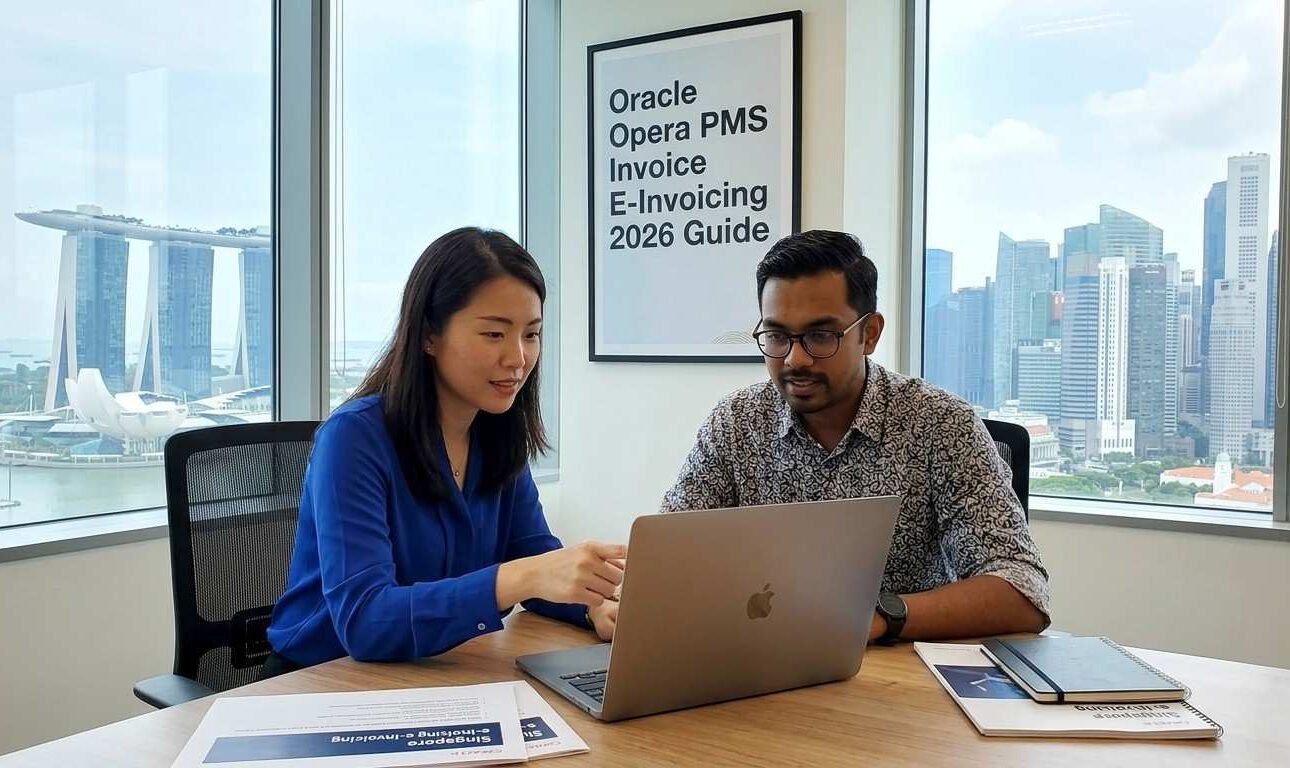
Hotels across Southeast Asia and the Middle East are managing a compliance shift that affects every transaction at the front desk, food and beverage outlet, and back-office billing desk. Governments are moving away from paper and PDF invoices toward structured digital submission through approved channels, and hospitality businesses are among the entities that must comply immediately. Oracle Opera PMS Invoice Invoice sits at the centre of this shift the property management system that drives room billing, folio management, and guest checkout must now connect directly to national e-invoicing networks. Getting that connection right requires deliberate configuration, field validation, and pre-go-live testing before a single compliant invoice leaves the property.
Opera PMS Integration with E-Invoicing
Opera PMS integration with national e-invoicing frameworks begins at the data layer. Every invoice produced by the property management system room folios, group billing summaries, banquet invoices, and ancillary charges — must carry mandatory fields defined by the relevant tax authority. A guest name and room rate are not enough. The issuing entity’s tax registration number, line-level tax amounts, a unique sequential document number with no gaps, and credit or debit note references to original documents are all required fields in most active mandates.
The integration architecture connects Oracle Opera PMS Invoice Invoice to an approved access point that handles structured document transmission. This access point receives formatted invoice data from the PMS, validates it against the mandate field list, and transmits the document to the tax authority network. A status response submitted, validated, accepted, or flagged returns to the property system for every document. Finance teams at the property level get clear visibility on each transaction without manual follow-up.
Oracle Opera PMS Invoice Invoice compliance requires testing against the live tax authority environment before any production invoice goes through. A general capability in the PMS software does not confirm that a specific property’s instance is correctly configured. Field mapping, tax code assignments, and access point connectivity all need structured verification. Many hospitality businesses also compare their workflows with platforms like FreshBooks cloud invoicing when evaluating digital invoice automation capabilities.
Hotel Billing Automation via E-Invoice
Hotel e invoicing replaces manual billing steps with a configured workflow that runs from checkout through tax authority submission without staff handling between stages. Traditional hotel billing typically involves front desk staff printing a folio, a finance team member reviewing and emailing a PDF, and a separate reconciliation step at month end. Each manual stage introduces the possibility of a field error, a missing reference number, or a sequential numbering gap all of which trigger rejection when the mandate is active.
Hospitality invoice automation through a correctly configured Oracle Opera PMS Invoice Invoice setup. Invoice creation at checkout, sequential numbering, field validation, and transmission to the e-invoicing network run through the system. An error caught at pre-submission validation takes seconds to correct. The same error caught after network rejection adds document correction, resubmission, buyer notification, and audit trail updates all of which delay payment and consume staff hours.
For hotel groups managing multiple properties, hotel billing automation through a centralised PMS configuration carries a practical benefit: a single implementation covers every property on the same platform. Field mapping and access point connectivity configured at the group level applies across the estate without property-by-property rebuilds in any Oracle Opera PMS Invoice Invoice environment. Enterprise hospitality groups using Gen10 ERP software often adopt similar centralized integration strategies for operational consistency.
InvoiceNow Integration with Opera PMS
Singapore’s InvoiceNow network is one of the most active structured invoice mandates in the region. GST-registered businesses above a defined revenue threshold are already required to transmit invoices through the Peppol network, and the mandate is expanding. Hotels operating in Singapore — leisure, business, or serviced apartment properties — fall within scope when they reach the registration threshold. This transition is also accelerating the adoption of Singapore B2B E-Invoicing processes across the hospitality industry.
InvoiceNow integration with Opera PMS requires the property management system to produce UBL-formatted invoice documents carrying all mandatory Singapore fields: the entity’s GST registration number, line-level tax amounts, a Peppol-registered access point for transmission, and document references that satisfy IRAS audit requirements. A formatted PDF sent by email does not meet the InvoiceNow standard regardless of how complete the transaction data is.
The access point connecting Opera PMS to the InvoiceNow network handles document formatting, transmission, and status return. Hotels that configure this connection correctly move invoices through corporate buyer procurement queues without the manual review that unstructured documents require. Payment confirmation arrives faster, and the audit trail is maintained automatically.
Digital Invoice Workflow for Hospitality
Digital hotel billing that meets e-invoicing compliance requirements covers more than room folios. Group billing packages, event and banquet invoices, advance deposits, credit notes for cancelled bookings, and debit notes for additional charges all fall within scope under most active mandates. Each document type in a Oracle Opera PMS Invoice Invoice setup must carry mandatory fields and travel through the same approved transmission channel.
ERP PMS invoicing environments that handle group and event billing face additional complexity. A consolidated group invoice must still carry line-level tax amounts, correct tax codes for each charge category, and a unique sequential number within the property’s continuous numbering sequence. Gaps in the sequence or incorrect tax codes trigger rejection at the network level.
Digital hotel billing built for compliance also covers the guest-facing side of the transaction. Corporate buyers in many markets require structured invoices from their hotel suppliers before approving payment. Properties that deliver compliant structured documents on checkout remove a common friction point in the corporate account relationship and reduce payment delays caused by buyer-side manual review. Some finance teams transitioning from legacy tools such as the Abel accounting system are now moving toward integrated PMS and e-invoicing environments.
Compliance and Automation in Hotel Billing
Compliance in hotel billing under an active e-invoicing mandate is not confirmed by having Oracle Opera PMS Invoice Invoice installed without configuration. It is confirmed when the specific property installation has been configured for the relevant mandate’s field requirements, document types, and transmission channel — and when that configuration has been tested against the live tax authority environment. Software capability in a product description reflects what the system supports, not what a particular hotel’s instance is set up to do.
The ERP PMS invoicing compliance verification process covers three elements simultaneously. Field mapping must match the mandatory field list for the relevant jurisdiction: tax registration numbers, line-level amounts, sequential numbering, and document cross-references. Document type coverage must include every invoice category the property issues. Access point connectivity must be live and tested, not assumed from a technical specification. Properties operating within the UAE e-invoicing system framework must ensure every transmission requirement is validated before production deployment.
Oracle Opera PMS Invoice Invoice automation that runs through a correctly configured system produces a compliance benefit alongside the operational one: automatic audit readiness. Transmission logs, validation records, and archived documents are maintained by the system without separate manual effort. When a tax authority review request arrives, the property does not need a preparation scramble the records are already structured and accessible.
The operational gains from a correctly configured setup are measurable within the first few billing cycles:
- Faster payment cycles: compliant invoices move through corporate buyer queues without the manual review that unstructured documents require.
- Lower rejection rates: pre-submission field validation catches errors in seconds rather than after network rejection adds resubmission cycles.
- Reduced admin overhead: when creation, numbering, and transmission run through the configured system, manual steps that generate most errors drop away.
- Automatic audit readiness: transmission logs and validation records are maintained by the system without separate manual effort.
- Stronger corporate account relationships: delivering compliant structured invoices at checkout removes a common payment friction point with large buyers.
Advintek Opera PMS E-Invoicing Solutions
The right approach to Oracle Opera PMS Invoice Invoice compliance is not determined by what a vendor’s feature page lists. It is determined by how the system is configured in the actual property environment, which document types the hotel issues, and whether the transmission channel has been tested against the live tax authority network before production invoices go through.
For properties already running Oracle Opera, the key question is not whether the PMS can support e-invoicing in general it is whether the specific Oracle Opera PMS Invoice Invoice installation has been set up and verified for the relevant mandate. InvoiceNow integration for Singapore properties, FTA transmission for UAE properties, and other active regional mandates each carry their own field requirements and approved access point specifications.
Advintek configures and maintains Oracle Opera PMS e-Invoicing setups across active mandates in the region. Each implementation is scoped to the specific property environment — mandatory field coverage across every document type in use, a connected and tested access point, and a documented resubmission process ready before any production invoice goes through. For hotel groups operating across multiple markets, the same architecture handles additional mandates from a centralised environment. Regional businesses working with Oman Advintek also benefit from localized compliance and ERP integration expertise.
Conclusion
The e-invoicing mandates covering hospitality businesses are defined, and the implementation steps are knowable. The gap that creates problems for most properties is the distance between a PMS that lists e-invoicing in its capabilities and a property installation that has been correctly configured and tested for the relevant mandate. That gap does not close on its own, and deadline pressure makes it more expensive to address late. Contact Advintek to confirm your Oracle Opera PMS compliance position before the deadline creates a billing disruption.
FAQs
Q1: What is Oracle Opera PMS Invoice Invoice?
A structured digital invoice workflow connecting Opera PMS to approved tax authority networks.
Q2: Which hotels need e-invoicing compliance?
All GST or VAT-registered hospitality businesses in active mandate jurisdictions.
Q3: Does standard Opera PMS meet e-invoicing requirements automatically?
Only when explicitly configured for the mandate’s fields and transmission channel.
Q4: What document types does hotel e invoicing cover?
Room folios, group billing, event invoices, credit notes, debit notes, and advance deposits.
Q5: What is InvoiceNow integration for hotels?
Connecting Opera PMS to Singapore’s Peppol network for compliant GST invoice transmission.
Q6: How long does an Opera PMS e-invoicing implementation take?
Most implementations run two to six weeks, depending on the property environment.
Q7: Can one setup cover multiple hotel markets?
Yes, a centralised architecture handles additional mandates without rebuilding the configuration.
Q8: Can Advintek configure Opera PMS for e-invoicing compliance?
Yes, Advintek configures Opera PMS across active regional mandates with full testing.
Source by:
Image by Gemini