


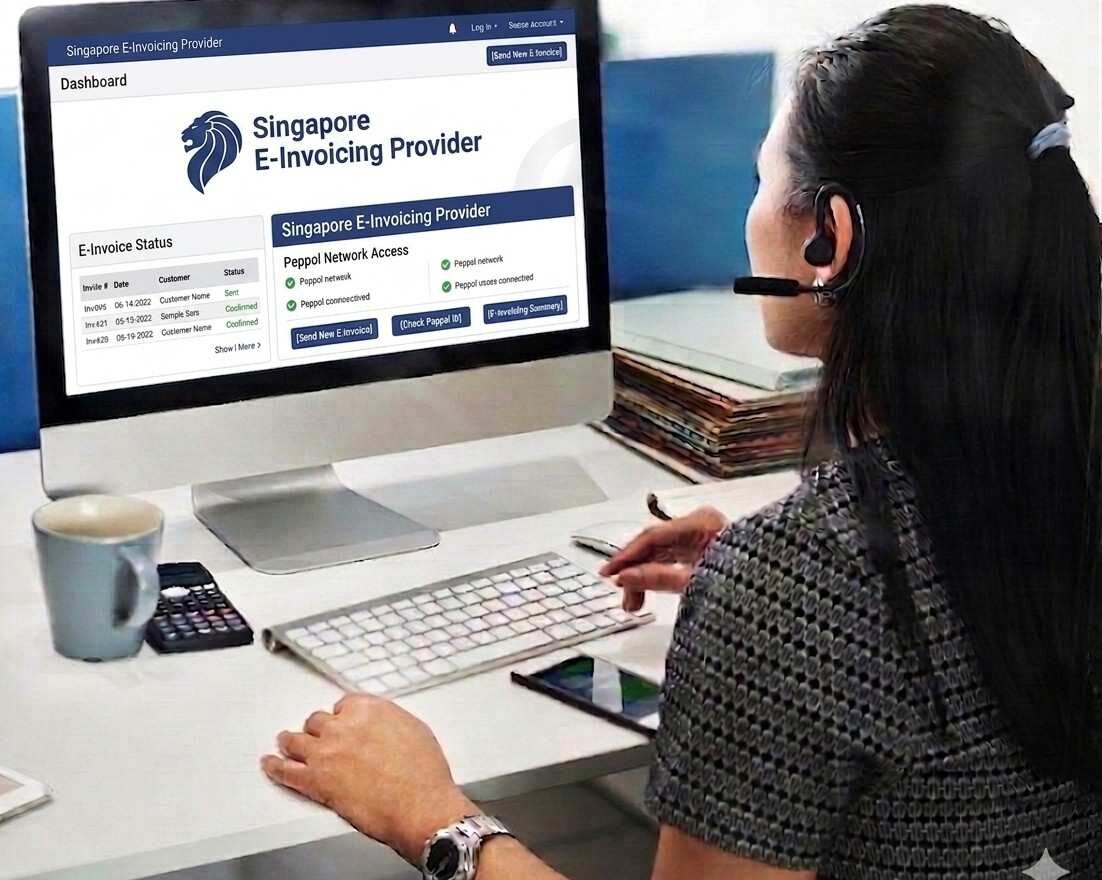
As Singapore accelerates its shift toward a fully digital business environment, picking the right Singapore e-invoicing provider has become a decisive operational choice. Businesses that get this right benefit from seamless InvoiceNow compliance, reduced administrative overhead, and a reliable audit trail — those that do not face rejection backlogs, manual rework, and financial penalties that compound quickly. With the PEPPOL-based InvoiceNow network expanding its mandatory coverage across business categories, 2026 is the year many organisations can no longer defer this decision. The wrong Singapore e-invoicing provider choice, on the other hand, can set a business back months.
How to Choose E-Invoicing Provider SG
Choosing a Singapore e-invoicing provider starts with confirming IMDA accreditation. Without it, a provider cannot transmit invoices through the PEPPOL network that InvoiceNow runs on — making compliance impossible from day one. This is a non-negotiable baseline, not a differentiating feature, and IMDA maintains a public register where accreditation status can be verified directly.
System integration is the next filter. Providers that connect natively with existing accounting platforms — whether that is AutoCount, Abel accounting system, or QuickBooks cash flow monitoring tools — eliminate double-entry and reduce reconciliation errors that pile up over time. Businesses running Apparel21 ERP software in retail or fashion should specifically verify compatibility, since not every Singapore e-invoicing provider supports specialised ERP environments out of the box.
Local support rounds out the picture. A Singapore-based team familiar with IRAS requirements resolves issues faster than offshore support reading from generic scripts — a gap that only becomes visible when something goes wrong at a critical moment.
Features of Certified InvoiceNow Providers
Certified Singapore InvoiceNow providers transmit invoices in PEPPOL BIS Billing 3.0 format — the standardised structure that makes cross-entity exchange possible without bespoke setup for each trading partner.
Automated pre-submission validation catches errors before they reach the network. Field completeness, GST registration formatting, UEN accuracy, and line-item calculations are checked at the point of invoice creation rather than after a failed submission.
Every transmitted invoice is timestamped, logged, and retrievable. This audit trail satisfies IRAS retention requirements and allows finance teams to locate any historical transaction without manual reconstruction — a practical benefit when responding to queries months after the fact. Delivery confirmations also arrive in real time, so businesses know immediately when an invoice has been received and acknowledged by the recipient’s access point.
PEPPOL Access Point Provider Benefits
Operating through a PEPPOL Access Point provider connects a business to every other participant on the network. No bilateral setup is needed for each new trading relationship — interoperability is built in from day one. Any certified Singapore e-invoicing provider offering PEPPOL access gives businesses this reach automatically.
For businesses with cross-border operations, this matters beyond Singapore. The Malaysia e-invoice framework shares PEPPOL infrastructure with the InvoiceNow network, meaning cross-border submissions can be handled through a unified system rather than separate platforms.
Structured electronic invoices also compress receivables cycles. Recipients process PEPPOL invoices faster than PDF or paper equivalents because the data arrives ready for their accounting system — no keying, no conversion, no chasing confirmation of receipt. For SMEs managing working capital carefully, shorter receivables cycles have measurable cash flow impact, and real-time delivery acknowledgements remove the uncertainty that characterises email-based invoicing entirely.
Cloud Based E-Invoicing Solutions
Cloud-based Singapore e-invoicing providers remove server infrastructure, maintenance cycles, and IT overhead from the business entirely. Updates, security patches, and compliance changes are handled by the provider. The platform is accessible from any internet-connected device without VPN dependencies or device-specific installations — a practical benefit for finance teams working across locations or hybrid arrangements.
Subscription pricing converts unpredictable upgrade costs into a fixed monthly or annual operating expense. Scaling — adding users or transaction volume — follows a defined pricing structure rather than triggering unplanned infrastructure spend.
Security governance on reputable cloud platforms typically exceeds what SMEs maintain with desktop installations. Encryption in transit and at rest, role-based access controls, and centralised access revocation when staff depart all reduce risk meaningfully. When an employee leaves, access is withdrawn immediately — no locally installed copy of the software remains accessible on a device outside the business’s control.
Comparison of Top Providers in Singapore
International platforms extending PEPPOL connectivity to Singapore as one of many markets bring broad accounting functionality — some businesses already use QuickBooks cash flow monitoring features alongside these tools — but they frequently treat local compliance as an extension rather than a core design principle. Businesses running Apparel21 ERP software and similar industry-specific platforms often find that edge cases like non-standard GST treatments, IRAS audit report formats, and local payment gateways expose this gap quickly.
A local Singapore e-invoicing provider, built specifically for this market, handles these specifics more reliably. Teams familiar with IRAS and IMDA obligations — and with local platforms like Abel accounting system — bring a level of operational detail that international vendors simply cannot match from a distance.
Pricing models also vary considerably. Per-transaction rates suit high-volume operations; flat subscription tiers work better for predictable monthly volumes. What separates a good Singapore e-invoicing provider from a frustrating one, though, is often implementation clarity — structured onboarding with a defined go-live date matters more than headline pricing when a compliance deadline is approaching.
Advintek Trusted E-Invoicing Provider
Advintek is a certified PEPPOL Access Point provider holding IMDA InvoiceNow accreditation. Invoices transmit directly through the PEPPOL network in BIS Billing 3.0 format without intermediate portal steps or manual reformatting.
Singapore compliance — GST calculations, UEN validation, IRAS-compliant audit reports, local payment gateway connectivity — is built into the platform natively. Regulatory updates from IMDA or IRAS are applied as part of the existing subscription, so businesses receive compliance changes without managing a separate upgrade process.
For businesses operating across Singapore and Malaysia, Advintek provides cross-border invoicing capability that covers both Singapore InvoiceNow and Malaysia e-invoice requirements through a single platform. This eliminates the reconciliation risk that arises when invoicing data must be managed across separate systems.
What makes Advintek a trusted Singapore e-invoicing provider is recognition — from local accountants, auditors, and financial institutions. Records originating from a known, reputable system move through external processes like bank financing, audits, and due diligence more efficiently. For any business expecting external scrutiny in the medium term, that provenance carries weight. Advintek also functions as a Singapore e-invoicing provider with cross-market coverage, giving growing businesses a single compliance infrastructure that does not need to be rebuilt as they expand.
Conclusion
For Singapore businesses navigating mandatory e-invoicing requirements, the choice of Singapore e-invoicing provider carries long-term operational consequences. Providers with genuine local expertise, IMDA-accredited PEPPOL connectivity, and compliance built in from the ground up deliver a fundamentally different outcome than platforms adapted from global products. The right Singapore e-invoicing provider evolves alongside Singapore’s regulatory environment automatically — keeping businesses compliant without requiring active monitoring or periodic upgrade investment. The case for transitioning from manual or non-standardised invoicing becomes straightforward once the full cost of staying put is properly assessed.
Frequently Asked Questions (FAQs)
Q1: Is InvoiceNow mandatory for all Singapore businesses?
Adoption is being phased — check IMDA’s current mandate schedule for your business category.
Q2: Can one provider handle both Singapore and Malaysia e-invoice requirements?
Yes — PEPPOL-certified providers with cross-border capability support both frameworks.
Q3: How quickly can a business go live with a new provider?
Most SMEs reach operational capability within one to two weeks with structured onboarding.
Q4: Does e-invoicing integrate with existing accounting software?
Most providers connect with common platforms — confirm your specific system is supported first.
Q5: Is local support available from Singapore e-invoicing providers?
Reputable local providers offer Singapore business hours support — confirm before selecting.
Source by:
Image by Gemini